2026-05-29
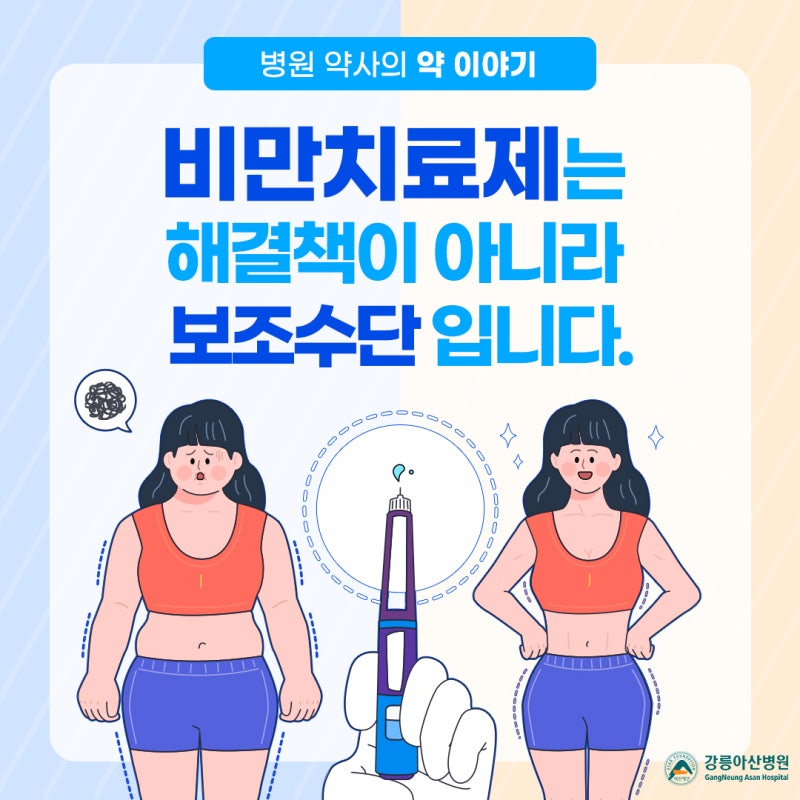
Obesity Medication is an ‘Aid,’ Not a ‘Solution’
Learn why GLP-1 obesity injections should be used as medical aids under professional supervision, not as simple diet shortcuts, to avoid serious health risks.

Gangneung Asan Hospital Pharmacy Team
Se-jin Kim, UM
Were you tempted by the ‘weight-loss injection’?😲

Recently, as celebrities and influencers share stories on TV and social media about losing weight quickly through ‘obesity injections,’ interest in specific obesity medications has exploded. Reviews claiming ‘my appetite vanished’ or ‘I lost weight with this shot even without exercising’ are spreading online, leading many to view these drugs as simple weight-loss supplements or general diet pills. Alarmingly, there is an increasing number of dangerous cases where individuals purchase these drugs without a doctor’s diagnosis or ignore dosage instructions after seeing drug names and usage methods shared online.
You might lose your ‘health’ instead of just fat🚨
The injectable obesity treatments currently in vogue belong to the ‘GLP-1 agonist’ class of drugs. Originally developed to treat type 2 diabetes, they began to be used for obesity management after their weight-loss effects were confirmed. GLP-1 (Glucagon-Like Peptide-1) is a hormone naturally released by our bodies when we consume food. It promotes insulin secretion, delays gastric emptying to increase satiety, and suppresses appetite.
However, these medications are not for everyone. They are prescribed only under a doctor’s discretion for adults with a Body Mass Index (BMI) of 30 or higher (obesity), or a BMI of 27 or higher with weight-related conditions such as hypertension, diabetes, or sleep apnea. Approaching these drugs purely for aesthetic purposes or as a substitute for a lack of willpower can be a shortcut to damaging your health.
The problem is that these drugs are being easily distributed through social media, overseas direct purchases, and illegal channels without medical supervision. As these are injectables that require refrigeration, improper distribution risks damaging the drug’s efficacy or causing spoilage. In some cases, the ingredients may be unbalanced or contain harmful substances, posing a serious threat to the user’s health. Even more concerning are the severe side effects that can occur without medical guidance. Reported side effects include nausea, vomiting, dehydration, headaches, and dizziness, as well as more serious conditions like acute pancreatitis, gallstones, cholecystitis, increased heart rate, and thyroid disorders, which can lead to emergencies in severe cases.
Obesity medication is merely an ‘aid,’ not a ‘solution.’
Long-term weight management must be accompanied by consistent dietary control, exercise, and lifestyle improvements. Attempting to lose weight through medication alone will eventually lead to side effects such as the yo-yo effect or decreased metabolic function. Notably, there are many cases where weight is rapidly regained after discontinuing the medication.
With the recent launch of another powerful injectable obesity treatment, it is highly likely that this trend will flare up again. However, for any medication, the most important factor is ‘for whom and how’ it is used. Obesity treatments can only be safe and effective when used based on medical evidence under the diagnosis and guidance of a medical professional.
Medicine does not become ‘real medicine’ through self-diagnosis; it requires a professional. Please do not forget that your health is far more important than fleeting trends or anecdotal reviews!