2026-05-29
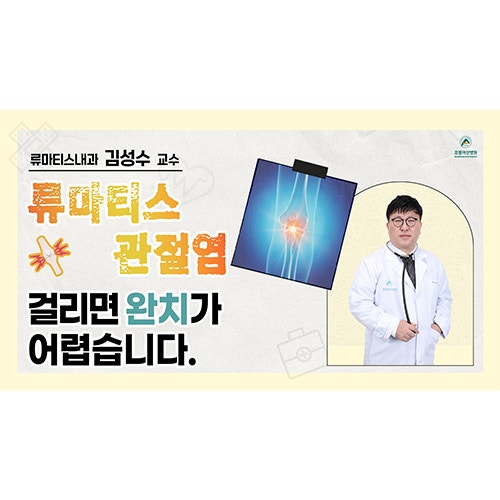
[Smart Doctor] Rheumatoid Arthritis: Difficult to Cure Once It Develops
Learn about rheumatoid arthritis, a chronic autoimmune disease. While a complete cure is difficult, early diagnosis and consistent management can lead to remission.
![[Smart Doctor] Rheumatoid Arthritis: Difficult to Cure Once It Develops](/uploads/hi_gnah/224066439143/ad7f8680faf7af2d.png)
Q. What is rheumatoid arthritis?
Rheumatoid arthritis is a chronic inflammatory disease that occurs when our body’s immune system malfunctions, attacking its own joints instead of external invaders like bacteria or viruses. This causes inflammation inside the joint lining (synovium), which can lead to joint damage and deformity over time. As an autoimmune disease, immune cells that should normally protect the body attack the joints. Representative symptoms include swollen and painful joints, and morning stiffness in the hands that lasts for more than an hour. It typically starts in small joints like the fingers, wrists, and toes, often affecting both sides symmetrically. Systemic symptoms may include easy fatigue, mild fever, or weight loss.
Q. Is rheumatoid arthritis hereditary?
While rheumatoid arthritis is not a genetic disease directly inherited from parents, genetic predisposition can play a significant role in its onset. If a family member has rheumatoid arthritis, the risk may be higher than for the general population. A well-known related gene is HLA-DRB1, but having this gene does not mean the disease will definitely develop. In fact, even if a parent is a patient, most children do not develop the disease.
Environmental factors such as smoking, chronic infections like periodontitis, hormonal changes, or stress can also influence the condition through lifestyle habits. Therefore, if you have a family history, it is important to pay attention to health management and early diagnosis.
Q. What foods are good to eat?
There are no specific foods strictly defined as ‘good’ or ‘bad’ for rheumatoid arthritis. However, there are certainly dietary habits that help joint health by reducing inflammation. Frequently consume fish, vegetables, and nuts, while reducing fried foods, processed foods, and red meat. It is also advisable not to drink much alcohol. It is effective to consistently observe and adjust your dietary habits to suit you. The important thing is to maintain a balanced diet and an appropriate weight. This is because increased weight puts a greater burden on the joints, which can worsen symptoms. Reducing the load on joints through weight management is crucial.
Q. What kind of exercise is helpful?
For patients with rheumatoid arthritis, exercise is very important for protecting joints, strengthening muscles, and maintaining bodily functions. Resting for too long can weaken muscles, making joints more unstable and decreasing function. Exercise is a part of rheumatoid arthritis treatment. Rest when in pain, and when symptoms improve, start with walking, swimming, or light strength training. A point of caution is to avoid excessive exercise and get plenty of rest during the acute phase when joints are swollen and pain is severe. It is best to resume exercise slowly once the pain subsides, and do not forget to stretch before and after exercising. However, if pain intensifies during exercise, you must stop immediately and consult a specialist.
Q. Is a complete cure for rheumatoid arthritis possible?
Rheumatoid arthritis is currently a chronic disease that is difficult to cure completely. However, if diagnosed early and treated consistently, joint damage can be almost entirely prevented, allowing for a normal daily life. With recent advancements in treatment methods, an increasing number of patients are reaching a state of ‘complete remission,’ where symptoms are virtually nonexistent. In a state of remission, there is little to no pain or stiffness, and one can live a nearly normal life. Rheumatoid arthritis is a disease that must be managed for a lifetime. If early treatment is delayed or management is neglected, joint damage and deformity can progress. Therefore, it is important to visit the hospital regularly and adhere to medication and healthy lifestyle habits. Since symptoms can worsen again if treatment is stopped, you must follow the medical staff’s instructions.
Q. Are acupuncture, oriental medicine, or supplements helpful?
The foundation of rheumatoid arthritis treatment is proven medication. While acupuncture, oriental medicine, functional health foods, and supplements may help some patients with temporary pain relief or symptom mitigation, their effectiveness in fundamentally treating the disease or regulating immune abnormalities is not clear.
Oriental medical treatments such as acupuncture, moxibustion, and pharmacopuncture have few side effects and can play a supportive role in reducing pain and improving joint function relatively safely. However, rather than replacing treatment on their own, they must be combined with medication prescribed by professional medical staff. Among supplements, studies suggest that Omega-3 fatty acids may partially help alleviate inflammation and joint pain, and Vitamin D and calcium are recommended for preventing osteoporosis. Oriental medicine or health supplements are only supportive roles and are not ways to cure the disease. If you wish to use supportive methods while consistently receiving proven medical treatment, be sure to consult your doctor.
Consistent interest and appropriate treatment are the best ways to protect your joints and health!
Although rheumatoid arthritis is a chronic disease, you can maintain a sufficiently healthy daily life through early diagnosis, consistent treatment, and correct lifestyle habits. The important message for you is not to worry alone, but to consult with your primary physician at any time regarding treatment and management to solve it together. Consistent interest and appropriate treatment are the best ways to protect your joints and health. We sincerely support you in working together with hope to create a better tomorrow than today. Thank you.