2026-05-29
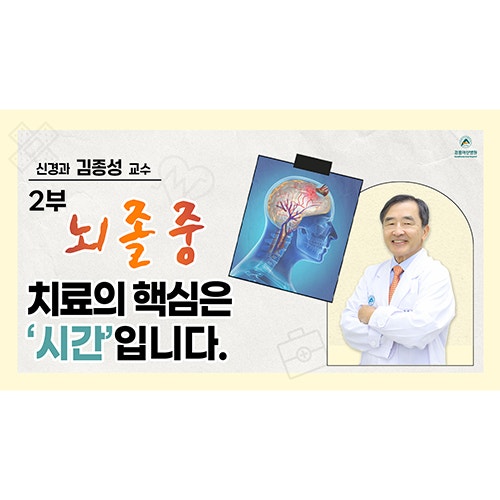
[Smart Doctor] Time is the 'key' to stroke treatment.⏳| Stroke Part 2
Learn about stroke treatment, including thrombolysis and thrombectomy, and essential prevention strategies like managing risk factors and medication.
![[Smart Doctor] Time is the 'key' to stroke treatment.⏳| Stroke Part 2](/uploads/hi_gnah/224047058911/ee98513d808bfe4e.jpg)

Q. How is stroke treated?
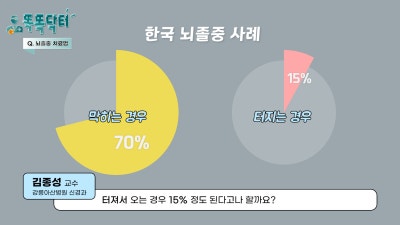
First, let's talk about the common type of stroke, where a blood vessel gets blocked. We call this ‘cerebral infarction’ or ‘ischemic stroke,’ and it accounts for the vast majority of cases. Currently, in Korea, about 70% of strokes are caused by blockages, while about 15% are caused by ruptures. Ruptures are generally more severe, so in the past, stroke was considered a dangerous, often fatal, and serious illness. However, risk factors have changed significantly over time, especially with better blood pressure control, which has reduced the incidence of ruptures. So, relatively speaking, we first examine whether there's a blockage or a rupture in the brain.
We start with a CT scan. A blocked area only begins to appear dark on a CT scan after 12 to 24 hours, but treatment needs to be administered quickly, within a few hours. So, even if we take a CT scan, nothing will show up immediately. Still, a CT scan is helpful because a ruptured area appears white, and that's what we're looking for. If it's a rupture, we treat it accordingly. For a blockage, if the patient arrives within 4.5 hours, there's medication to open the blocked blood vessel. Since a clot is causing the blockage, there's medication to dissolve the clotted blood. It's called a ‘thrombolytic agent.’ While there are various drugs, the only one actually used is ‘TPA.’ So, you only need to know ‘TPA.’ If a patient suddenly arrives at the emergency room with paralysis, administering TPA intravenously quickly is a crucial basic treatment method because the drug can travel and dissolve the blocked area. However, there are cases where it doesn't open even with TPA. Of course, this can happen if the patient arrives late, but it can also happen if they arrive early. This is because a large blood clot might be blocking the vessel.
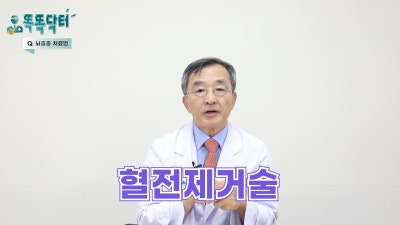
If it's a small clot, it can all be dissolved, but if it's large, the medication administered intravenously might not be enough to reach and dissolve it completely. So, if only one-third is dissolved, two-thirds remain blocked. The effect would naturally be minimal! Since the condition could worsen, if it's confirmed that the blood vessel remains blocked, we need to use another method. That's called ‘thrombectomy.’ A needle is inserted through the groin and a tube is advanced into the body all the way to the blocked area. There's a device that firmly grasps the clot. It grabs the clot and pulls it out of the body. Of course, TPA would have already been administered. If a ‘thrombectomy’ is performed in addition, blood flow improves, leading to a better outcome. So, first, we use the thrombolytic agent ‘TPA.’ If that doesn't work, we proceed with ‘thrombectomy.’ Both of these treatments can be performed within 24 hours! It's incredibly important that we keep open the possibility of performing both treatments for your recovery, and I want to emphasize that you, too, must actively participate in this treatment process.

Q. What are the prevention methods after stroke treatment?
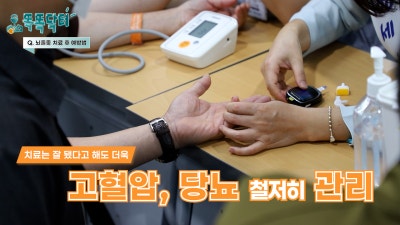
If you've had a stroke, early and effective treatment is crucial. After that, preventing recurrence is equally important. Even if the treatment was successful, you must rigorously manage hypertension and diabetes. Another point is that people with cardiac arrhythmias can have blood clots break off from the arrhythmia, travel to the brain, and cause a stroke. If you are one of these individuals, you must continue to take medication to prevent blood clots from forming in your heart. People with damaged blood vessels also need to take medication to prevent further clot formation. A well-known example is ‘aspirin.’ However, aspirin works by slightly dissolving clots and preventing platelets from clumping, so it does have side effects. Nevertheless, for those whose cerebral blood vessels are already damaged and have experienced a stroke, the risk of recurrence is higher than for the average person. Therefore, despite these minor side effects, aspirin is used because the benefits outweigh the risks.
By continuously taking such medication, we aim to prevent further problems in the blood vessels. Similarly, for patients with heart problems, taking medication that prevents clot formation is essential for stroke prevention. Therefore, continuous communication between the patient and doctor is important to strive to prevent another stroke from occurring.
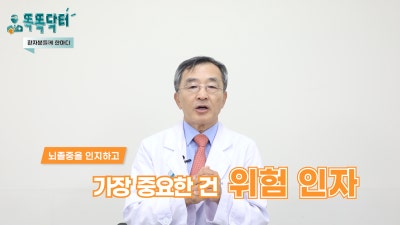
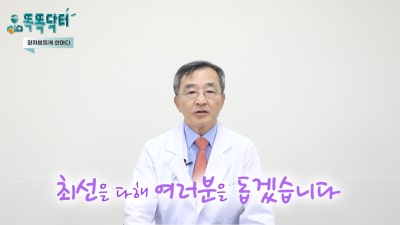
Continuous communication between patient and doctor is key to managing and preventing recurrence!
Understanding stroke and, importantly, the risk factors I mentioned, is vital. By avoiding these risk factors from a young age, you can live a long and healthy life free from stroke. So, please visit the neurology outpatient clinic anytime, consult with us, and we'll discuss prevention guidelines that suit you well. Let's make a lot of effort in our daily lives to prevent stroke. I emphasize these two points. We will do our best to help you. Thank you.





Frequently Asked Questions
What is the first test performed when a stroke occurs?
The first test performed is a CT scan. A CT scan is essential to differentiate between a hemorrhagic stroke (burst blood vessel) and an ischemic stroke (blocked blood vessel) to determine the correct treatment direction. The burst area appears white, and while the blocked area may not be clearly visible initially, it is crucial for confirming the presence of hemorrhage.
What is the golden hour for treating a blocked cerebral blood vessel?
Thrombolytic (TPA) administration should occur within 4.5 hours of symptom onset. Arriving at the emergency room within this timeframe for intravenous drug administration is necessary to effectively dissolve the blocked clot. If medication is not sufficient, thrombectomy should be performed within 24 hours.
What if thrombolytic therapy is not effective?
A thrombectomy will be performed as an additional procedure. If a large clot is blocking the vessel and cannot be dissolved by medication alone, a procedure is performed within 24 hours to physically remove the clot by inserting a tube and instruments through the groin into the blood vessel, thereby restoring blood flow.
What medication is taken to prevent stroke recurrence after treatment?
Mainly antithrombotic drugs like aspirin are taken. Patients with pre-existing cerebrovascular damage have a high risk of recurrence, so consistently taking medication to prevent platelets from hardening and forming new clots, even with minor side effects, is much more effective in prevention.
Can cardiac arrhythmia be a cause of stroke?
Yes, it can be a cause. In patients with cardiac arrhythmia, there is a risk that clots formed within the heart can break off, travel through the bloodstream to the brain, and block cerebral blood vessels. Therefore, patients with arrhythmia should consistently take medication to suppress clot formation and prevent stroke.